
Compost & Reduce Food Waste

Category

Waste & Recycling

Impact

Cost

$

Composting is easy magic! It turns food waste — which might now go into the trash or down the kitchen sink drain via the garbage disposal — into a rich, sweet-smelling soil amendment. Applied to garden beds, it enriches the soil environment for plants and for the millions of tiny decomposer organisms that live under our feet. Bonus: it reduces household trash volume significantly!    

Why compost? Incredibly, over 51% of the trash that goes to landfills is compostable. In the US, we throw out roughly 60 million tons of food each year, not only wasting valuable resources (food, and organic fertilizer) but also contributing to methane, a gas with a warming potential roughly 21 times that of carbon dioxide.

How to compost

  1. Backyard composting. Keep it simple. Four posts and some chicken wire will do for a start. It is best to have at least two side-by-side “bins”: one where the compost will mature, and one to hold grass clippings and leaves, which are important to layer with food scraps for faster and more complete decomposition. The leaves and grass clippings also discourage animals from searching out food scraps. You can also buy composting bins that do a good job.
  2. Take food waste to the transfer station. The Town of Wayland Transfer Station accepts food scraps and other organic waste, like grass, leaves, flowers, brush, twigs, logs (under 18” diameter), wood chips, and Christmas trees.
  3. Sign up with Black Earth curbside food scraps pickup: Choose a one-month or a six-month subscription, which is usually the best deal.
   

Steps to Take

  1. Decide if you want to compost in your backyard, take your food waste to the transfer station, or sign up for Black Earth pick up.
  2. If you sign up for Black Earth, follow these steps
    • Sign up on their site. Choose a one-month or a six-month subscription, which is usually the best deal.
    • Order a Starter Kit, which includes a critter-proof bin on wheels, a roll of bags to line it and keep it clean, and a roll of smaller bags for whatever container you use to collect compostables in the kitchen.
    • Once registered, you will receive instructions on where to pick up your Starter Kit in Wayland.
    • Let us know how it goes by contacting us or by leaving a testimonial (scroll to the bottom of page).

Instructional resources

Books

  • Let It Rot! The Gardener’s Guide to Composting, by Stu Campbell (an adult resource)
  • Compost: A Family Guide to Making Soil from Scraps, by Ben Raskin (a kid-friendly book on composting)
  • Compost Stew: An A to Z Recipe for the Earth, by Mary McKenna and Ashley Wolff (a fun rhyming book for younger kids

Documentaries

Deep Dive

U.S. Food Waste Facts 

  • Food waste is estimated to be 30–40% of the food supply. (U.S. Food and Drug Administration)
  • According to the World Wildlife Federation, the production of wasted food is equivalent to the greenhouse emissions of 37 million cars. (RTS)
  • Food waste is the single largest category of material municipal landfills, where it emits methane, a powerful greenhouse gas (GHG). Such solid-waste landfills are the third-largest source of human-related methane emissions in the U.S., accounting for approximately 14.1% of these emissions in 2017. (U.S. Department of Agriculture)
  • Food waste is a huge climate issue in the U.S. because, when it is placed in landfills, the anaerobic conditions cause its decomposition to generate methane, a potent GHG. By composting, we return this organic matter to the natural carbon cycle.
  • Although home composting does not solve our national food-waste dilemma, it is an important step down a better path. Community-wide composting can make an even greater impact. Nature’s capacity for carbon drawdown is extraordinary, and returning food waste to the soil is a significant part of the equation. This is an action that most of us can take together, each in our own household, to increase the health of the soil and of the climate!
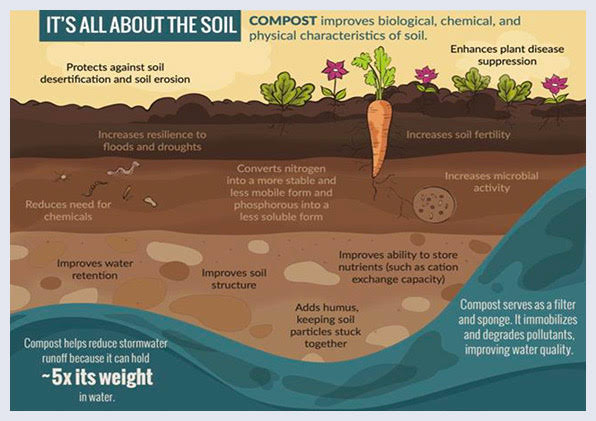
  • Healthy soil provides additional benefits, as the illustration below demonstrates. (Thanks to the Mothers Out Front Massachusetts Healthy Soils group for the graphic.)

  • It is estimated that for each ton of compost produced and used, one-half ton of CO2 can be sequestered in healthy soil. (BioCycle)
  • For every four households that adopt composting, a half ton of carbon is sequestered annually.
  • Every 1% increase in soil organic matter — thus, soil carbon content — adds 1.4 acre-inches (approximately 38,000 gallons) of water-holding capacity.” (Healthy Soils and The Climate Connection)

Add a Testimonial

0%

Subscribe to receive the Energize Wayland newsletter!

* indicates required
Email Preferences