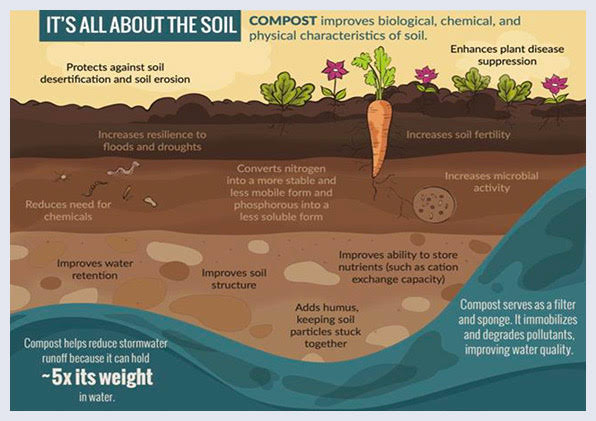
Composting is easy magic! It turns food waste — which might now go into the trash or down the kitchen sink drain via the garbage disposal — into a rich, sweet-smelling soil amendment. Applied to garden beds, it enriches the soil environment for plants and for the millions of tiny decomposer organisms that live under our feet. Bonus: it reduces household trash volume significantly!
Why compost? Incredibly, over 51% of the trash that goes to landfills is compostable. In the US, we throw out roughly 60 million tons of food each year, not only wasting valuable resources (food, and organic fertilizer) but also contributing to methane, a gas with a warming potential roughly 21 times that of carbon dioxide.
How to compost
- Backyard composting. Keep it simple. Four posts and some chicken wire will do for a start. It is best to have at least two side-by-side “bins”: one where the compost will mature, and one to hold grass clippings and leaves, which are important to layer with food scraps for faster and more complete decomposition. The leaves and grass clippings also discourage animals from searching out food scraps. You can also buy composting bins that do a good job.
- Take food waste to the transfer station. The Town of Wayland Transfer Station accepts food scraps and other organic waste, like grass, leaves, flowers, brush, twigs, logs (under 18” diameter), wood chips, and Christmas trees.
- Sign up with Black Earth curbside food scraps pickup: Choose a one-month or a six-month subscription, which is usually the best deal.